Sunday, 28 July 2013

The joys of camping

I was reminded by a far away friend recently that I hadn't published a post for a while. Firstly I felt rather flattered that anyone had noticed that I hadn't posted! I also realised that the comment was absolutely true and I had actually a fair bit that I could talk about. So much to talk about in fact that I decided my Sunday evening would be best spent practicing my newly honed touch typing skills in writing about the goings on of the last 6 weeks or so.

As I have mentioned previously, Canadians are very good at taking advantage of scarce  good weather and having fun outdoors. One of the most effective ways of doing this whilst also taking advantage of the beautiful scenery of this fabulous country, is to go camping. The joy of being able to drive somewhere new, pitch up a tent and enjoy campfire banter with good friends is something I never really embraced back home for reasons unbeknownst to me. Thus, I have made the conscious decision to atone for this mistake, especially as I live in the gorgeous province of Newfoundland.

In a bid to make sure this new concept really took hold, I decided to make an investment. Not much of an expensive investment, nor a volumetrically large investment, but an emotional investment in that I would feel guilty in buying gear and then not using it. And so with a determined mind I set off for Canadian Tire (the Canadian B&Q if you will) and bought the $30 tent that had been winning rave reviews on their website. Now I should point out that I was under no illusions as to what to expect from a $30 tent. It is not the type of tent you would aim to hike long distances with, although it packs down surprisingly well for a 3 man. It's not the type of tent that you would want to use in particularly inclement weather. But for the purpose of the car camping trips that I will be indulging in for the next year or so I thought/hoped it would be adequate. 
 My humble 3-man abode.
And so I was prepared to go on whatever adventures those with cars were prepared to take me on. My first jaunt was a trip to Northern Bay Sands, a gorgeous sandy beach on the other side of Conception Bay. The weather was set to be beautiful on Discovery Day weekend, which also coincided with the appearance of the Super Moon. With the cars loaded with vast amounts of goodies from Costco we set off on like John Cabot himself to an unexplored (for us at least) portion of the Avalon. On the way the eagle-eyed amongst us spotted some whales out in the bay, leading to a road side stop with the binoculars. The sight of a couple of Minke whales had already made our trip worthwhile. We were not to know of the treats around the corner.

Arriving at the campsite we managed to snag a great pitch and after setting up we quickly headed down the matter of metres to the beach. With St Johns' rocky coastline largely preventing daily frolicking in the sea the lure of the ocean was too much for us to resist.

Embracing the cold water.
Demonstrating our strength in fighting the not-so-mighty waves.
Playing Viking Chess on sand is infinitely more difficult than on grass.
After drying off and eating our Costco marinated pork chops, we then noticed something out to sea. There was an abundance of whale spouts popping up further up the bay. Quickly we bundled into the car and drove down there, for what turned out to be a whale bonanza. A group of approximately 30 humpback whales just having a time. We couldn't believe what we were seeing. They were the first whales I had ever seen, and their abundance and proximity has forever spoilt my expectations. I had to stop excitedly clicking away on my camera and just take it all in.

They did not try and hide their location at all, with spouts continuously erupting from the sea.
Showing some tail.
They got pretty close to the shore too.
The excited crew with a spectacular view.
We returned to camp on a high where we then proceeded to eat our body weight in smores and campfire popcorn under the glow of the Super Moon. The following day we planned to tour around the peninsula and take in the spectacular scenery that the Avalon affords. So after eating our body weight in bacon/things fried in bacon fat we leisurely travelled north, stopping at various picturesque bays hoping to once again find some whales.

One of the particular charms of this particular parts of the world is the unusual place names. As mentioned we were on the other side of Conception Bay. Driving south down Trinity Bay you come across the consecutive villages of Heart's Content, Heart's Desire, and Heart's Delight. Out to sea is a small rocky island, naturally called Shag Rock. But then there is the crowning glory of weird place names. Dildo. The origins of the name are unclear but Wikipedia postulates that it may be related to the phallus-shaped pin in a row boat used as a pivot for the oar. However it came about, we couldn't not stop for a photo with the town mascot.

Captain Dildo and the happy travellers.
Our enthusiasm for camping after this trip was followed up by a more ambitious plan. A two-night trip further west for Canada Day weekend. And so a happy band of campers (ironically none of us being Canadian) headed off to Central Newfoundland and Dildo Run Provincial Park (surprisingly nowhere near the town of Dildo previously mentioned.) The weather wasn't looking too great on our way up and we arrived 5 hours later under grey skies. We wandered around the beautiful inlet at the campsite and I tried to make the best of the weather by playing with my new fancy camera. After a brief rain shower the sun came out to play and after a feast of everything-smothered-in-garlic-butter we settled down ahead of the big day tomorrow.

Dildo Run. Not the worst view in the world even in the grey,
but infinitely improved with sunlight.
The following day we headed off across the Hamilton Sound to Fogo Island, one of the must-see tourist attractions in Newfoundland. I was naturally very excited as I'd heard wonderful things about the island. Also, I was going to an island, which meant that I was going on a ferry. And it was when we were approached the terminal at Farewell that everyone discovered how much I love ferries. I really love ferries. To me they mean going on an adventure somewhere, evoking memories of trips on the Mersey Ferry as a child, or on geological journeys to Scottish islands like Arran and Mull. And this trip was to be no exception.

Fogo Island is a picturesque step back to another time. There's quaint fishing houses nestled in rocky bays that must be harsher than they appear in the light of summer. The houses are as colourful as they are in the rest of Newfoundland but have a different feel to them (especially when you take photos of them in miniature mode with a new camera). Then there is Brimstone Head, a volcanic promontory that is alleged to be one of the four corners of the world by the Flat Earth Society. And you could see why. Despite not having the time to walk the trail it was easy to imagine why this place felt like the edge of the earth.

FERRY TIME!!!
Miniature matchstick houses.
The artsy monstrosity that is the new Fogo Island Inn, where a room
can set you back $1000 if you are so inclined... 
In the town of Fogo itself we come across some locals playing some jigs and reels.
Brimstone Head at the edge of the earth.
On our final day (Canada Day itself) we headed up to Twillingate, the so-called Iceberg Capital of the world. 2013 has been a somewhat poor year for icebergs in comparison to recent years. I don't think many have made it as far east as St John's at least. Unfortunately we didn't see any while we were in Twillingate, but that doesn't mean it was a wasted excursion. Crow Head afforded majestic views, as well as a coffee shop with excellent flavoured lattes. Fuelled on caffeine we started our journey back to St John's, but not without stopping for lunch at the Chelsea's Fish & Chip van, where their infamous 26 foot lobster provides a unique photo oppotunity

Fabulous colours helped by excellent geology.
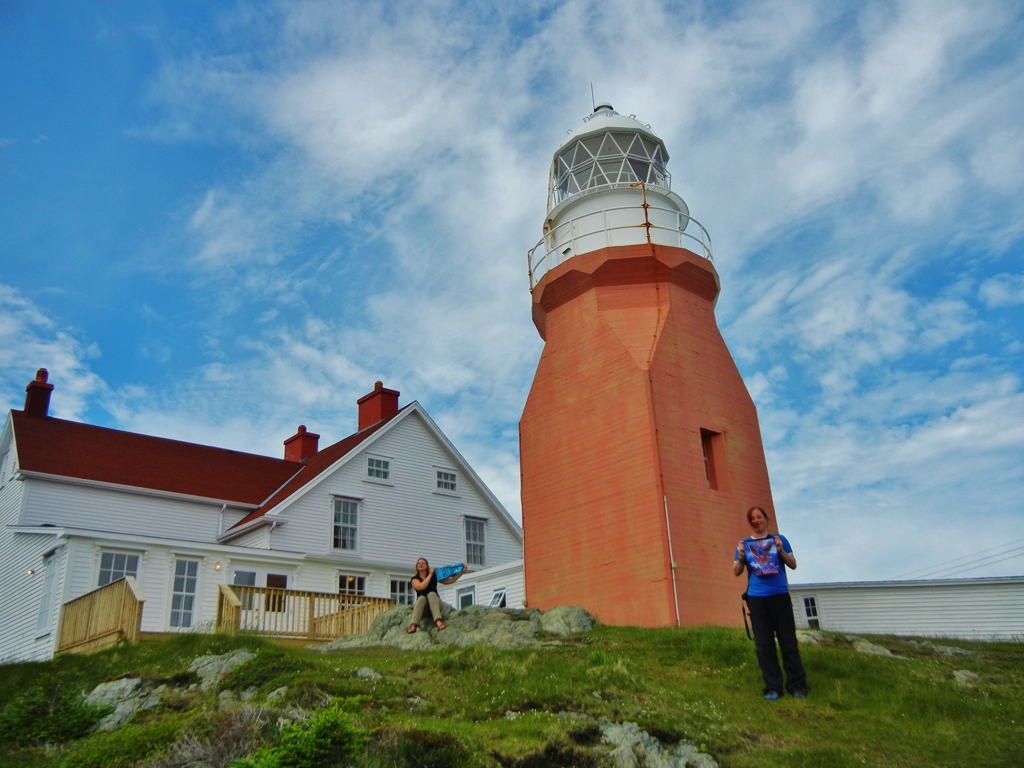
The flag at Long Point Lighthouse. 
I don't know what more I can say about this. 
Arriving back in St John's I was definitely hit by the post-holiday lull. The excitement of travelling around the island quickly evaporated with the feeling of exhaustion and annoyance at the amount of dishes my housemates had left in the sink. The joys reappeared as quickly though once I had looked back through and edited my photos. It had been a fabulous adventure and I was not going to let my housemates bring me down. I had spent the weekend falling in love with more of this island. My new tent had now survived two trips and dealt with some moderate rain and wind. And I had plans in place for an another, even bigger adventure in the coming weeks. It is this which forms the basis of my next narrative...

Thursday, 6 June 2013

How to be a geochronologist - Part 1

I thought I would do a post explaining what I've actually been up to in Canada in terms of work, as I'm aware it appears that I do very little geology. I'm going to start with some of the lab work I've been up to, and what happens to the rocks after I collect them in the field, and what answers I'm trying to get out of them. But don't worry, I won't bore you guys with the in depth account of my research proposal and why I'm doing this particularly project (although my proposal is a good read!). 

Basically a previous study of these rocks had found some pretty interesting geochemical characteristics in the rocks (the ones I collected from California in December) that we weren't expecting, specifically to do with the ages we were getting from the analyses. The parts of the rocks that we typically get ages for rocks from these days are excruciatingly tiny minerals (definitely <1mm) like zircon and monazite. These minerals are surprisingly tough little blighters that form in molten rocks that pop up in the earth's crust, and are then found in rocks like my granites. During their lifetime they are very good at recording the chemistry of the magma around them, as well as picking up signatures of other things that happen to them, like if they get attacked by fluids deep underground or up at the surface. Using fancy equipment we can measure the chemistry of these minerals and figure out what happened to the minerals, and most importantly, when it happened.


As I said, these minerals are tiny. You can't see them in the rock with your eyes. You may be able to see them in the microscope if they're big and you're a hawk. So how do we get them out of the rock and in a state where we can measure them? Well...

You get your rocks, of which there may be a couple kilograms of chunks like this,

Using this array of metal slabs, nuts, washers, ethanol and tools,


Dolled up in a dust mask, safety glasses and ear protectors, you submit your rocks to a number of medieval torture methods...

Splitting (put the rock in between these two teeth and squeeze until it breaks into smaller chunks, if the US Postal Service haven't adequately broken up your samples for you),
Crushing (use big metal plates that move towards and away from each other to crush the rocks into chunks a couple of centimetres big),
Milling (use two rotating disks to grind the rocks down into a sandy powder),
Using the terrifyingly named "Pulverizer",
Quartering (to split your sand sample into 4 representative portions,
And then sieving to get rid of the coarser material and the finer dust (that volunteer job working with aggregates did come in handy afterall!).
After all this dusty manual labour, which involves a lot of heavy duty duct tape and brown paper, you are then ready to do some science! The zircon and monazite grains we're after are all about the same size as the rest of the sand grains. But how do we then separate out the <5% of grains that we need from everything else? Well helpfully zircon and monazite are largely denser than most of the other stuff in the sand. So using the "heavy liquid technique" we mix our sample with a really dense chemical called methylene iodide and thanks its density...
The lighter stuff (quartz, feldspars and micas, that we don't want) floats to the top (where all the grey crap is),
And the heavier stuff (zircon, monazite and garnet if it's there) sinks to the bottom, where we can tap it off and move onto the next step,
All the while rocking the lab coat, safety glasses and latex gloves look, that at least makes you look more like a scientist than a construction worker.
You can then separate out the good stuff even more by using the Frantz magnetic separator. By this point we've already removed the actual magnetic stuff with a big hand magnet, but all the stuff that's left is paramagnetic and dimagnetic which means they can still interact with magnetic fields but in different ways. This big ol' electromagnet takes advantage of that, and by varying the strength of the magnetic field and/or the slope of the chute you can separate out the zircon and monazite, and anything else that's still knocking about.

You set the kit up with a bit of arts and crafts skill. The sample (a couple grams worth of tiny minerals in my case) goes in the funnel to top right,
And passes through the electromagnet and splits down the shoot into two fractions, which we then collect in our weighing paper boxes.

From here the process involves physically picking the grains and putting them on a mount, which we can then put in one of our analytical machines to get our geochemical and geochronological data. Now, may I remind you again that these grains are very small! It takes a bit of practice and a lot of concentration to be able to use the really fine tweezers to pick up the grains and move them. Especially as monazite tends to shatter into a million pieces if you squeeze it too hard. To help keep focused and to prevent being spooked by any sudden noises I tend to blast carefully constructed playlists of classic rock that I can sing along to. This approach has largely succeeded, and my singing is very effective at keeping people out of the lab!

Big fancy microscope,
With a wee dish containing one of the fractions separated out before, mixed with some ethanol to make it easier to pick grains up.
Camera attached to the microscope helps with identification. The golden brown grains are typically monazite, whereas zircon, found in one of the other fractions, is completely clear and typically with pointy pyramid ends.
Once located and picked up with the tweezers grains are moved, whilst trying your utmost not to drop them, to another microscope,
Where they are placed carefully onto super strong sticky back tape on the mount,
And after a picking a few hundred garins begins to look something a little like this. That little red bar is 1mm in size. I told you these things were small!
After the grains are on the mount they are coated in epoxy and polished down to make the final mount. This is the stage i am currently up to; I'm waiting for some new epoxy to arrive and then before you know it we'll be shooting lasers at the grains and getting data out of them! Well that's the plan anyways. I will write about the next stage of the process when it happens and I have some pretty pictures to accompany. Until next time y'all...

Wednesday, 29 May 2013

Avalonian adventures

A while back I had the selfish feeling that other than meeting wonderful people over here and having fabulous times with them, I hadn't done very much in Newfoundland that I couldn't have done anywhere else. The response from a friend was (quite rightly) that firstly, it had been winter, a major issue when it comes to going anywhere in Canada. I have since learnt that the moment a bit of sunshine appears Canadians take full advantage and cram as much into that precious time as possible. 

Another limiting factor to my travel plans is that I can't drive. Therefore I don't have a car. And public transport doesn't take you further than the city bounds of St John's. The train service stopped in 1988 (I never thought I'd miss the trains...). My complaining had clearly galvanised the group, and within the week one friend decided to overcome these obstacles,hire a car and plan an adventure.

Bell Island is a wee (and by wee I genuinely mean it; it's 34 sq km) island off the Avalon Peninsula in Conception Bay. It's a place that you're told you only have visit the once, but seeing as the iron mine tour wasn't open when we went, I'll likely end up going twice. Setting off in our little city car, which we named Myrtle, we headed to Portugal Cove to catch the ferry. Filled with excited expectations of a good weather forecast our hope were initially dashed when ...
...we were greeted with the foggy view those from Newfoundland are all too used to.
After a quick tea break we boarded the ferry and hoped for the best and thankfully we were not disappointed.


We left the fog behind and forged on into clear skies.
And Bell Island came into view.

We left Myrtle along the tracks on the SW corner of the island,
And walked along the coast gazing into the tropical looking seas and the sedimentary successions that get the 6th floor geologists all riled up.
We found the "Bell" (stack to the right) and the "Clanger" (stack to the left) and proceeded to our lunch spot (off towards the right of this photo).
With the beautiful view we had we settled down for a wonderful lunch of pasta salad, chocolate wafer straws and beer. Eventually we decided to go have a look at the rest of the island. And by that I mean that we drove round its entire perimeter and went to see the lighthouse...

...where we showed some expert timer and panoramic skills,
Before heading to Dicks' famous chippy for the best fish supper I've had this side of the Atlantic (more of my views on Newfoundland food in another post).
Eventually we decided to return to the mainland (still an island I know) and take the long route home taking in the scenes from a variety of different towns along the way.

This included a tea stop at the end of the day at Pouch Cove (inexplicably pronounced Pooch). 
The weather carried on for a few days after the car had been returned and the sun has been nice overall for the last few weeks now. That was until of course the Bank Holiday weekend that is. Normally the "May 2-4", where Canadians simultaneously celebrate Queen Victoria's birthday and Queen Elizabeth's official birthday, is the first big camping weekend of the summer. The weather however was naturally horrific.

Nonetheless on the Monday some of us decided to drive out to Cape Spear, a place I had also been complaining about not having visited, as it's literally down the road from town. And when better to visit the most easterly point in North America than on a wet and windy miserable day!

The hood was very much necessary.
The waves roared up and crashed on the Torridonian-esque rocky shoreline.
A WWII gun battery installed to defend the St John's coast.
I've visited the most westerly point of mainland Britain and now the most easterly point of North America :)
Having spent 4 years in St Andrews, moving to St John's has made me go cold-turkey in terms of beaches. These hard rocky coastlines aren't too conducive to making lovely 3 mile long that charecterise East fife, but the do exist in places such as Middle Cove, just to the north of town. This was the site of my first beach BBQ in Canada. Armed with wood, marshmallows and sausages we met up at the beach and got our fire started, helped by the surprisingly flammable kindling of Doritos. The beach was full of other people who had the same idea and as the sun went down we were encountered a firework display, a fire dancer who earned a round of applause from the crowd and even a Star Wars reenactment with light sabres. 

The gang chilling with a few beers.
Bratwurst on the BBQ
Stargazing and chilling by the fire (gutted I was caught on my phone!)
Photos stolen from the wonderful Edgars Rudzitis.
Summer is just beginning here and long may it continue to be beautiful. Last year was incredible in terms of temperature and sunshine, whilst the year before was awful and rainy. A happy medium would be good for me. After all my pasty complexion can't take too much sun! Either way I'm happier in the fact that I know I will have fun with my friends and I'll get out and see more stuff all over this island I now call home. But wait, aren't I supposed to be doing a Master's right now?..

Tuesday, 16 April 2013

Identity Crisis

I was asked tuther day “Where are you actually from Stacy?” That’s not been an uncommon question for me over the last 8 months. Having an English accent in Canada begs the question. My responses typically vary and while trying not to be condescending I often just simply respond with “England”. Lots of people then tut and say “Well duh, I knew that”. I have to start big as I have actually been called Australian since being over here, much to my confusion. I then start to whittle down the English geography and respond from North West of England —> Lancashire —> Halfway between Liverpool and Manchester —> Skelmersdale (which I rarely reach). I assume that nobody knows where anywhere in England, or the United Kingdom actually is. And why should they, I am only just getting to grips with Canadian geography, and I’m still only at the provincial scale.

Alternatively I have had people say “Oh, I thought you were from Scotland because that’s all you talk about”. My time spent there and my love for all things north of the border clearly hasn’t gone unnoticed. This got me thinking about where I actually associate myself with. While for other people I know this is a legitimate crisis, spread out over the global scale, my relatively local allegiances are still varied and eclectic. The nostalgia that I get for the places I’m associated with are principally expressed as sporting teams that I cheer for, and my vernacular vocabulary. And I don’t mind having a diversity of ‘nationalities’. (It spreads out my chance for sporting success!). But I thought I would reflect on the places that have shaped who I have become. (That was unexpectedly soppy…)
To me Skelmersdale is the crossroads that merges several local cultures and diverse accents. Geographically we are situated in Lancashire, and are served by West Lancashire County Council. However we have a Wigan based Postcode. And we are mainly populated by former residents of Liverpool, as our wee Norse-named colliery town was expanded to to house the overflow of people from Merseyside. Anyone with an appreciation for these Northern nuances will understand my identity confusion.

Liverpool is my football team. Forever and always. I joke about allegiances to various teams, but this one is one of my die-hards. You’ll Never Walk Alone will always be a song and a motto that I adhere to, creating strong bonds with the millions of LFC fans globally and meaning I am a true friend to those I care about. Feeling part of the Liverpool community is particularly important every April 15th, with the anniversary of the Hillsborough disaster. JFT96 and YNWA are emblazoned across social media. It also transcends team rivalries. This event affected Liverpool as a city, and further afield. We may hate the Mancs and Evertonians but for this, we stand united. In summary, I’m a Scouser, just without the phlegmy accent.
Me and Champions League Trophy
Showing my Liverpool pride with the Champions League Trophy
DSCN1251
The city itself is one of my favourite places too. Where else would you get  Superlambananas?
Wigan has probably had more of an effect on my accent and culture, mainly due to proximity. It’s easier for me to get to Wigan than to Liverpool, and I went to college there. Wigan Warriors are my rugby team too, and being a season ticket holder for 4 years means that some of the most exciting and impassioned moments of my life so far have occurred wearing the cherry and white hoops, sitting in the South Stand of the JJB Stadium. I also love steak and ale pies, which is an entry requirement for calling yourself a Wiganer.
Me and Paull at JJB
Cherry and Whites on a stadium tour.
Chris Ashton Flip try
I've been waiting for an excuse to show this shot of Chris Ashton (now of England Rugby Union Fame) being the extravagant player that everyone now knows.
The Lancashire connection is mainly reserved for pissing off those from Yorkshire. I never really felt the Lancashire connection in Skelmersdale. It was only when I was selected to shoot for Lancashire at archery that that identity came in. It’s not the same as those from Lancashire-proper like Preston, Lancaster and Burnley, who also retain the accent, but we can all unite to antagonise those from across the Pennines whilst eating a Hotpot. Red rose til i die.
DSCN4242
The beautiful river plains of the Lancashire Lune Valley
Scotland is where it gets interesting. My mum’s family are from Fife, the wee peninsula that is host to the University of St Andrews where I did my undergraduate degree. Like my Gran was, I was very proud to be representing the family at the local prestigious university, although upset that the local connection not providing me with any scholarship money! Numerous family holidays to Scotland over the years meant that I was aware of my Scottish heritage and I had embraced it before I started studying there. I think the fact that I studied Geology in Scotland is an important part of my view of the country. Some of the best moments and most incredible views i have seen have been in the hills, valleys and coastlines of Scotland. Having a deeper understanding of these incredible landscapes has strengthened the bond, and while I wouldn’t be audacious enough to say to a proud Scotsman that I myself was Scottish, I am always quick to point out my many connections to the wonderful country.
Panorama 1 - Copy
Ardnamurchan peninsula looking north towards the islands of
Canna, Rum and  Eigg (L-R)
DSCN2555
Beautiful autumnal views from Ben Nevis looking towards Fort William.
I was born in Cardiff, Wales, but was only there for 6 months before we moved up north. Again family holidays and trips around Wales have allowed me to learn about the fabulous country and its people. I find Cardiff itself a wonderful city, with a fabulous castle and a stadium that has provided me with some great victories. While I feel that I am not truly Welsh, I am a great admirer of those who are.
DSCN1439
At Llanfair PG, the village in Anglesey with the longest name in Europe and one of the longest in the world. One day I will learn how to pronounce it.

Being English is the undisputable identity that I possess, and of that I am proud. I have been lucky enough to travel to a number of towns and cities throughout the land thanks to my dad’s job as a courier. Years spent sitting in the van and staring out of the window experiencing different parts of the country has been a fabulous opportunity. That is in no way saying that I am done exploring the place. My UK Scratch Map will not scratch off itself! It was only when I went to St Andrew’s that I had the resource to visit the Lake District on a regular basis. Despite being the next county up from Lancashire I had never visited it before. There’s many places yet to go, and the next chance I have I will seize it.
DSC06199
Derwent Water below Catbells in the Lake District.
DSCN3859
I fortuitously managed to explore the south east this summer, so i walked the White Cliffs of Dover!
The bucket term for all of this drivel, is that I am British. It is the best way to incorporate all the different loyalties I feel. The question in geology of “Are you a lumper or a splitter?” is pertinent here, and I would say that it is circumstantial. All I wish is that calling myself British is not a dilution of who I am, and calling myself a Wiganer is not a disservice to the other influences on my life. And who knows, maybe in a year and a half when I'm addicted to Tim Horton's and ice hockey I'll start trying to call myself Canadian as well!